Article Summary
Every brand says they want fans. Very few know how to build them. At Idea Lab 2026, a panel of marketing and sponsorship leaders broke down why most brand activations fail to create lasting fandom, what the brands that earn real advocates actually do differently, and where AI fits into the equation without replacing the human judgment that fandom requires.
Key Takeaways
- Fandom is not awareness. A fan advocates for your brand without being asked, in rooms you've never been in. That's a fundamentally different outcome than impressions or reach.
- Most brands start with what they want to say and find a cultural moment to attach it to. The brands that build real fans start with the audience and work backward.
- Before activating on any cultural moment, run a three-part test: do you have permission to be here, are you adding value to the fan, and does it ladder to a business objective?
- Sustainable activations tend to go deep, not big. The TD x Vancouver Canucks girls hockey clinic reached 40 participants and generated more genuine advocacy than most large-scale media buys.
- AI is compressing the time teams spend on research, reporting, and response infrastructure. That frees up capacity for the strategic and creative work that actually differentiates.
- Fandom is emotional. Data can track it, but only human judgment can build it.
Related Video
Full Article
The problem with how most brands chase fandom
Every brand says they want fans. Very few actually know how to build them.
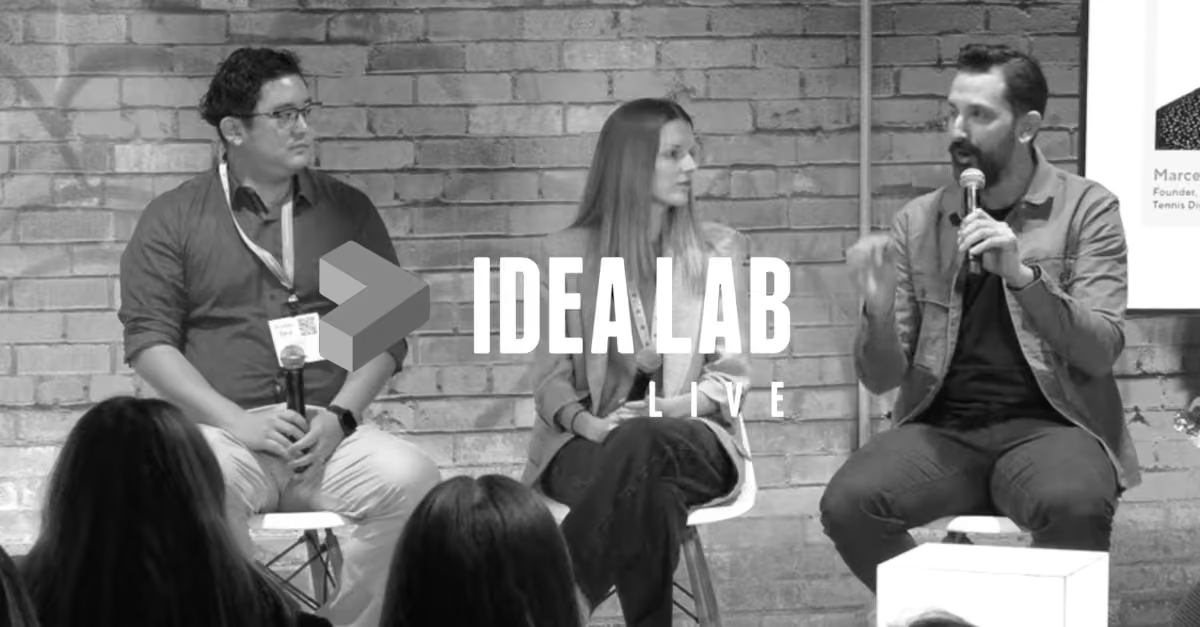
I had the chance to sit on a panel at Idea Lab 2026 alongside some sharp minds in sports marketing, sponsorship, and brand strategy. Jen Rooney, Managing Director at Staples Promotional Products Canada, hosted and moderated. Our conversation kept circling back to the same uncomfortable truth: most brands are doing fandom backward.
They start with what they want to say. They find a cultural moment to attach it to. They show up big. Then they disappear. Audiences can smell that from a mile away. The brands that actually build fans? They start with the person.
What fandom actually means
Fandom is not awareness. It is not reach. It is not impressions. A fan is someone who advocates for you without being asked. Someone who tells the story of your brand to people you have never met, in rooms you have never been in. Getting there requires a shift in how you write briefs, choose moments, and measure success.
Lindsay Tulloch, VP of Partnerships at T1 Agency, put it simply: fandom cannot be manufactured, and it cannot be bought. The brands that earn it are the ones who care about what the fan cares about, not just during the campaign, but year round. She pointed to the Olympics as a clear example. You see enormous media spending during a two to four week window. Then most of those brands vanish. Meanwhile, the brands that invest in grassroots development, that grow the sport, that show up when the cameras are off, those are the ones that build lasting permission to be part of that culture.
Giordan Sora, VP of Experiences at Diamond and Campaign's 2025 Producer of the Year, framed it this way: the best brands do not try to own culture. They elevate it.
From my side, working with B2B brands at Tennis, fandom looks a little different, but the root is the same. Great brands understand their clients intimately. They know what their clients are interested in and what problems they are trying to solve, and they try to meet them where they are. Over time, that builds something closer to fandom than most B2B companies realize is possible. We wrote about this dynamic in more depth in Helping, Not Selling.
The three-part test for deciding if a moment is worth it
With limited budgets and unlimited cultural moments to chase, how do you decide where to show up?
Lindsay shared a framework that our whole panel agreed on. Before committing to any activation, a sponsorship, a cultural moment, a trend, ask three questions:
First, do you have permission to be here? Does this align with your values internally? Will your own employees buy into it? If the answer is no, it will not come through externally either.
Second, are you adding value to the fan? Are you alleviating a pain point? Creating something the fan actually wants? Or are you just inserting yourself and getting in the way?
Third, are you adding value to the business? Your CFO is not signing off on a multi-million dollar sponsorship just to delight fans. What does this lead to? Awareness, perception shift, advocacy? Know the answer before you activate.
All three have to be true.
The activation that stopped the room
Giordan shared a program I have not been able to stop thinking about since the panel.
More than one in five girls drop out of sport in their teens. TD and the Vancouver Canucks partnered to address that directly. Not through a campaign. Through a clinic. They invited girls inside Rogers Arena, gave them ice time in a building that almost no one gets to set foot on, and created space for a real conversation about what sport gives back: confidence, resilience, community.
No massive media buy. No elaborate production build. No attempt to manufacture a moment.
Just 40 young women stepping onto NHL ice and looking up at 18,000 empty seats. Becoming fans for life.
Giordan put the ROI in human terms: 40 fans on the ice, 80 more in the stands watching their daughters light up. Then those 120 people went home and told that story to everyone they knew.
That is what fandom looks like. That is what earned media actually means.
The lesson for every marketer in that room was simple. The question is not "how do we go big?" The question is "how do we go deep?"
Where AI fits and where it doesn't
We spent a significant portion of the panel on AI. It is impossible to have a conversation about marketing strategy in 2026 without it.
My take, from running an agency that uses these tools every day:
AI is good at work that takes time but does not make you win. The smartest teams I see are using it to compress time spent on setup, research, deck building, and reporting so the humans in the room can focus on the thinking that actually matters.
Giordan made a point I loved: take an RFP. Traditionally, 80% of your time goes toward understanding the problem and building the response infrastructure. Only 20% goes toward the work that wins the business. AI can flip that ratio almost entirely.
Lindsay described how her team at T1 uses AI for always-on measurement across sponsorship portfolios: logo tracking, social listening, brand health, perception lift. That kind of continuous monitoring previously required custom research studies that can run $30,000 to $50,000 each. AI is compressing that cost and making it ongoing rather than periodic.
But here is the thing that matters most, and it came up near the end of our panel when someone in the audience asked about job security.
AI is built entirely on what already exists. It is extraordinary at defining the box, synthesizing everything that has been thought, written, and tested before. But it cannot think outside the box because it is not designed to.
If you are a strategist, a creative, or a marketer, your job is to find the gaps. To see what is not there yet. AI will never do that, because it can only pattern-match against the past.
Use it for the in-the-box work. Free yourself up for the rest. That is leverage, not a threat.
What I took away from the room
The through line across every topic we covered, fandom, activation, AI, was the same. Start with the person. Whether you are choosing a cultural moment, writing a brief, or deciding where to deploy AI in your workflow, the question that matters is: does this make someone's experience better? If you are starting with what the brand wants to say, you are already behind. Start with what the audience needs, show up when it counts (and when nobody is watching), and save AI for the work that clears space for real thinking.
Fandom is emotional. Data can track it, but only human judgment can build it.
About the panelists
- Jen Rooney, Managing Director at Staples Promotional Products Canada. Host and moderator of the Idea Lab 2026 panel on turning moments into momentum.
- Lindsay O'Brien, VP of Partnerships at T1 Agency. Over 15 years of experience across sports, entertainment, and talent partnerships. Previously with Molson Coors and MLSE.
- Giordan Sora, VP of Experiences at Diamond. Campaign's 2025 Producer of the Year. MBA and over a decade of agency experience leading global award-winning programs.
- Marcello Gortana, MBA and Founder at Tennis. A next-generation web and product design agency helping B2B companies transform their websites into growth engines.
Frequently Asked Questions (FAQ)
What is brand fandom and why does it matter?
Brand fandom is when customers move beyond purchasing to actively advocating for a brand, telling others about it, and identifying with it as part of their own identity. It matters because advocates generate organic reach, reduce customer acquisition costs, and create a loyalty baseline that advertising alone cannot build.
How do brands build genuine fandom?
Genuine fandom starts with the audience rather than the brand message. Brands that earn fans understand their customers' journeys intimately, show up consistently rather than only during big moments, and focus on elevating the experience rather than inserting their message into it.
How should brands decide which cultural moments to activate on?
Use a three-part test. Does the brand have genuine permission to be in this space? Does the activation add meaningful value to the fan experience? Does it ladder up to measurable business objectives? If all three answers are yes, it is worth pursuing. If any one is missing, reconsider.
Can fandom be manufactured through marketing?
No. Audiences are highly attuned to brands that show up opportunistically and disappear. Fandom requires sustained investment, genuine alignment with what the audience cares about, and a long term presence. A campaign can spark interest, but only consistency converts that interest into advocacy.
Where does AI fit into brand and fandom strategy?
AI is most useful for measurement, research synthesis, consumer insight generation, and workflow efficiency. It can identify patterns faster than any team, enable always-on brand health monitoring, and compress the cost of research studies that previously ran tens of thousands of dollars per cycle. But fandom is emotional. AI can track it. It cannot generate it.
What makes a brand activation sustainable?
Sustainable activations tend to use existing infrastructure rather than custom builds, focus on depth of impact over breadth of reach, and create experiences that participants genuinely want to talk about afterward. The TD x Vancouver Canucks girls hockey clinic is a strong example: maximum human impact, minimal production budget, and a story that spread organically from 120 people in the building to their entire networks.
How can B2B brands build fandom?
In B2B, fandom looks more like deep audience engagement and community. It starts with understanding your ideal client profile in detail, their day-to-day responsibilities, aspirations, and pain points, and then meeting them where they already are with genuinely useful tools, content, and resources. Helping, not selling, is the foundation.