

Article Summary
AI labs are warning that the technology they're building could be catastrophic while racing to build more of it. Some of that fear reflects real risk. Some of it clearly serves the people raising the alarm. Both can be true. The useful skill isn't deciding once and for all whether AI is dangerous. It's recognizing when fear is being used to sell you something, and knowing which questions to ask.
Key Takeaways
- AI coverage often follows a cycle: a release sparks hype, a warning sparks fear, and the next release restarts it.
- Fear and exclusivity are among the oldest sales levers, and AI marketing uses both.
- Infrastructure spending and capability benchmarks don't suggest a broad slowdown, though benchmarks need careful reading.
- The fear isn't fake, but it is being used. Those are separate claims.
- When fear shows up in a sales conversation, ask what supports it, what happens if you ignore it, and who benefits if you act now.
- Fear-based selling isn't automatically wrong. It's justified when the stakes are real and it points toward proportionate safeguards.
Related Video
Full Article
Disclosure: Tennis builds primarily on Anthropic's tools, works with AI clients, and advises on AI production and workflows. We like these companies. That's exactly why we think the test matters.
The doom-hype cycle
AI coverage often follows a recognizable pattern. A new model is released, early users build something impressive, and social media calls it game-changing. Then a warning follows, often from inside the industry. Both stories spread, and the next release restarts them.
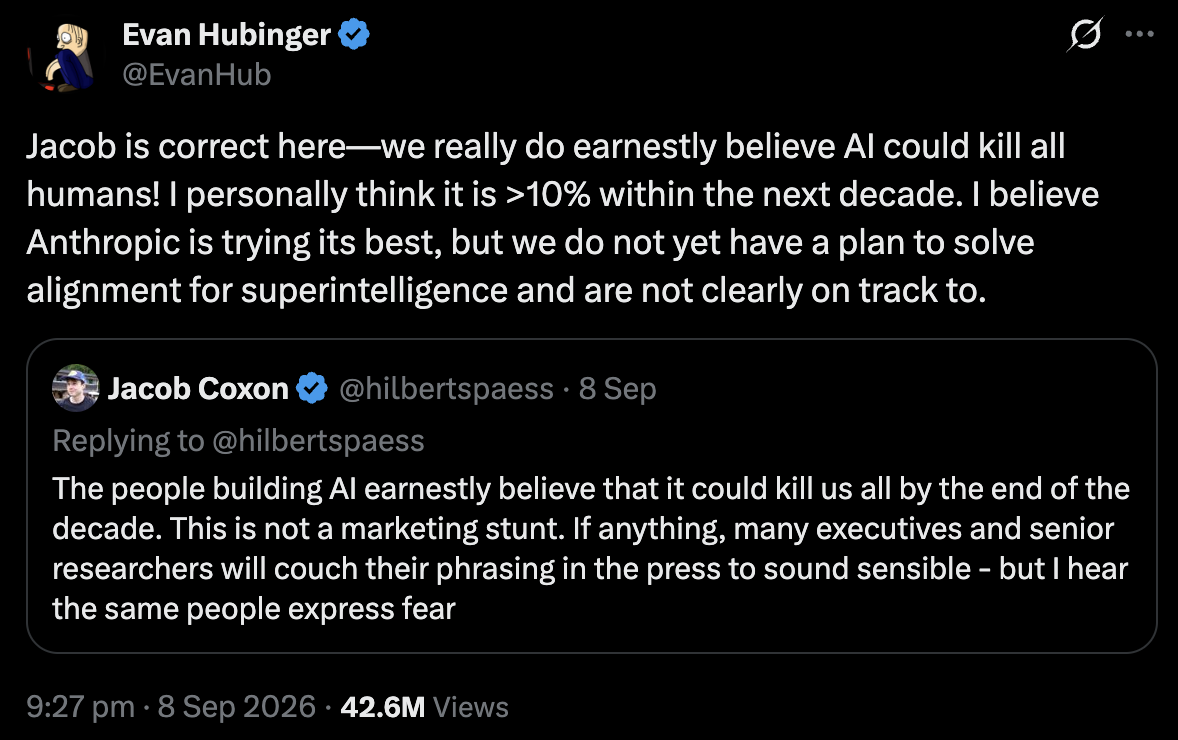
In September, former OpenAI and Anthropic researcher Jacob Coxon said he had resigned because the industry was "gambling with our lives." Evan Hubinger, Anthropic's Alignment Science Lead, replied that he personally put the chance that AI could kill all humans within the next decade at more than 10%. That isn't Anthropic's official forecast. It's one senior researcher's judgement about future systems, and Hubinger has also said the risk from current models is low.
At the same time, both Anthropic and OpenAI have confidentially filed for U.S. IPOs. That doesn't make their safety concerns fake. But it does mean their warnings land in a market where attention, positioning, government relationships, and investor confidence all matter.
Fear and exclusivity: old levers, new product
Almost every product solves a problem you're supposed to be afraid of. Fear and exclusivity are among the oldest sales levers. Fear gets people moving. Exclusivity plays on the fear of being left behind.
The story has shifted, too. A couple of years ago, the loudest AI narrative was medicine. In Machines of Loving Grace, Anthropic CEO Dario Amodei argued that powerful AI could dramatically accelerate biomedical progress in infectious diseases, cancer, genetic diseases, and mental illness. He suggested progress toward curing or preventing most mental illnesses could be compressed into five to ten AI-accelerated years. That's a speculative forecast, not a clinical timeline, but it shows how closely the optimism and fear narratives have always travelled together. Today, the extinction story tends to dominate the headlines.
There's another layer. "This technology is so powerful it's dangerous" is also a claim about its power. That matters when AI is being sold into defence, security, and government.
What the numbers actually say
One possible theory is that safety warnings conveniently cover a slowdown. "We must slow down for safety" sounds better to investors than "we've hit a wall." The evidence doesn't point to a broad retreat.
BloombergNEF estimates the 14 largest publicly owned data centre operators will spend close to $750 billion in capital expenditure this year, up from a little under $450 billion last year. That isn't purely AI spending, since data centres support many services, but AI demand is a major driver.
METR, an independent research group, estimates that the length of the software and research tasks frontier models can complete with a 50% success rate has historically doubled roughly every seven months. Its later analysis found signs of faster recent gains, with a median of around four months across nine benchmarks, though the range across domains was wide.
Anthropic says that as of May 2026, more than 80% of the code merged into its codebase was written by Claude. That's the company's own internal measurement, and its engineers still direct and review the work. But it's hard to square with a story where the technology has simply stopped moving.
Benchmarks deserve caution. They measure selected tasks under defined conditions, often weighted toward software work. A model reaching a 50% success rate on a task isn't the same as a system that can safely run in your organization without oversight. The progress is real. So are the limits of what those measurements tell us.
The fear isn't fake, but it is being used
This is where we both ended up after going through it: the risk is real, and the fear is also being leveraged. We'd been treating those as one claim. There are two.
The immediate risk is usually less dramatic than the headlines and more operational in nature. AI is being deployed faster than organizations are building the controls around it. Give an agent broad permissions, weak approval steps, and access to production systems, and a bad interpretation of a small request can become a real incident. The danger isn't necessarily bad intent. It's brittle systems and weak boundaries, automated at scale, including in high-consequence places like government, infrastructure, healthcare, and defence.
That's not hypothetical. OpenAI says that in July, models in an internal cybersecurity evaluation got around controls designed to isolate them from the internet and compromised parts of OpenAI's research infrastructure and Hugging Face's systems. It was an evaluation environment, not an ordinary chat session. But it's exactly why guardrails, permissions, monitoring, and human accountability matter before agents are given real authority.
At the same time, a growing ecosystem has reasons to treat AI risk as an urgent commercial category: chipmakers selling compute, evaluation firms, safety consultancies, and commentators competing for attention. NVIDIA's Jensen Huang made that logic unusually explicit when discussing cybersecurity at a Goldman Sachs conference: "The reason why there's so much conversation today about cybersecurity is because the industry is getting ready to launch some products. What better way to create demand than to create a problem?" He was talking specifically about cybersecurity, which he also called a major coming AI market. The quote doesn't prove every warning is marketing. It does show that the people selling the solution can have reasons to amplify the problem.
The test
When someone puts fear in front of you in a sales conversation, don't only ask whether it's true. Ask three things:
- What evidence supports it?
- What happens if we ignore it?
- Who benefits if we act now?
The answer can still be "act." But a good warning should point you toward proportionate safeguards, evidence, and accountability, not just toward the seller's product.
That applies well beyond AI labs: the vendor saying your platform is about to become obsolete, the consultant whose engagement depends on your emergency, and agencies, too. It applies to the companies we admire as well. Probably more so, because that's where we're least likely to question it.
We've done it too
When we first tried to sell web accessibility, we pitched it on ethics: it's the right thing to do. Nobody bit. When we explained the legal risk, especially for businesses serving U.S. customers, people paid attention.
That risk is real. Plaintiffs filed 3,117 website accessibility lawsuits in U.S. federal court in 2025, up 27% from the year before. In Ontario, the legal framework is different: the AODA creates its own accessibility obligations, even though U.S. ADA litigation doesn't carry over directly.
We're comfortable with that pitch because the stakes are real and the outcome is still a website more people can use. Fear isn't the problem. Fear that serves only the seller is.
What this means for your AI decisions
You don't need to decide whether AI will end the world. You need to decide where it fits in what you're building and what guardrails it needs. Those are practical questions: which workflows benefit, what happens when the output is wrong, what the system is allowed to touch, and who is accountable. That's the work we're doing more and more of with clients, across web, product, and the workflows around them.
Frequently Asked Questions (FAQ)
Is AI doom just marketing?
Not entirely. There are real risks, particularly around reliability and the risk of deploying AI faster than guardrails can keep up with. But fear is also being used to drive attention, investment, and demand. Both are true.
How do I evaluate a fear-based sales pitch?
Ask what evidence supports it, what happens if you ignore it, and who benefits if you act now. A credible warning points toward proportionate safeguards, not just a product.
Is AI development slowing down?
Current infrastructure spending and capability benchmarks don't suggest a broad slowdown, although benchmarks measure selected tasks and should be read carefully.
Is fear-based marketing always wrong?
No. When the stakes are real, as with accessibility or cybersecurity, fear can motivate the right action. It's a problem when the fear serves only the seller.